20 July 2020

Winter Projects and Updates

Brrrrrrrrr! It's been a pretty cold and wet winter here at Pine Hill. We love the rain, of course, and our dams and tanks are full to overflowing, but it's starting to get a bit old now. Bring on spring!

This post will showcase our major creek rehabilitation project, funded with a grant from the local water management authority. It's a project that would have involved tree planting parties and working bees had COVID not shoved its snout in and stuffed everything up! So, it's just been me and Charles doing all the hard work, but actually it's turned out really well. There's nothing quite like planting in a beautiful quiet space with a running creek in the background to get your mind off the troubles of the world.

I've been putting videos and pictures up more regularly on our Facebook page - Pine Hill Equestrian - if that is something you're interested in. Apologies to those who have been following that because the images are reproduced here.
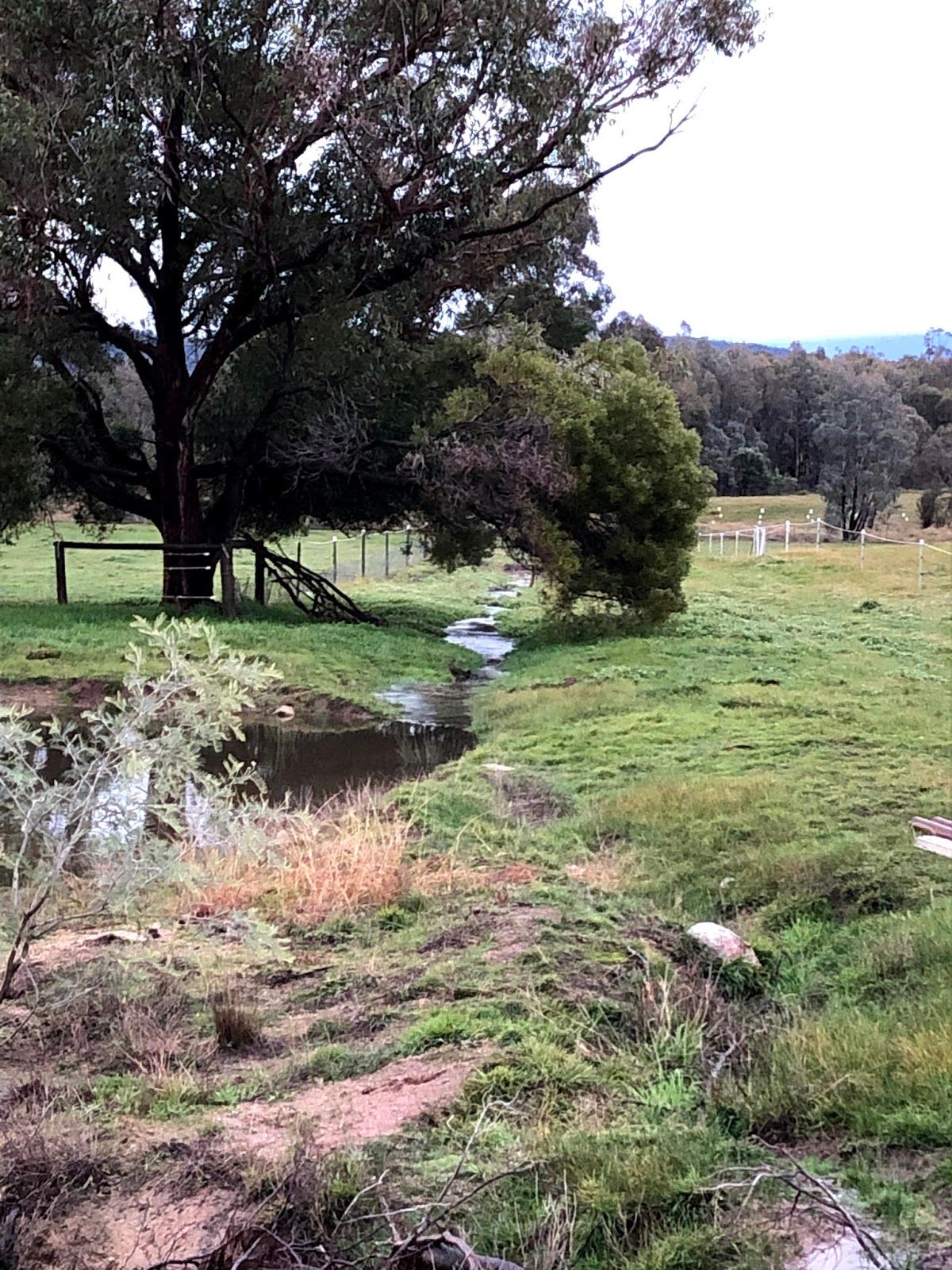
This photo shows the bottom half of our creek and you can see the fencing on either side. This area of creek does not run often - only after significant and consistent rainfall. You can't seek all the planting (yet!) but our hope is, once those grasses, bushes and trees start to take hold, the water table will be brought more consistently to the surface and the creek will run more regularly. Maybe even all year round!

You can see the young wattle tree growing in the left foreground. This was planted about 18 months ago and the pond you can see mid-picture is actually a large eroded area that may slowly fill in (or not!) as the creek recovers.

The big tree is actually two trees almost entwined - one a Blackwood (I've planted a heap of those now!), and the other a gum of some kind. These are the only large, mature native trees for at least 300 metres.


 This is the new loafing area the clever Charles built. The water trough is installed here (not visible in this pic as it hadn't been installed when this was taken) and the horses already enjoy hanging around in here instead of on the pasture. Eventually, the 'back paddock' that is on the right of the picture, and is currently about 30 acres, will be divided into four paddocks connected to this loafing area. One paddock will hopefully produce hay, down the track.

The creek runs down the left of this shot, and you can see the big trees in the background. I have planted several trees around the loafing area and the pond though we are looking at shade options for the next few years while those trees grow.

 This is the midway point of the creek and, as you can seek, a favourite area for the kids to play in - even in winter! The creek runs over large rocks and forms this little pool. There is always water in this pool, even in the height of summer.

I planted a lot of rushes, lillies, and a water-loving species of tea tree here to help slow and filter the water as it runs down the hill. There are always frogs and birds around here.

In the rocky surrounding areas, I planted various plants and grasses with some red gums and apple boxes. This place already looks so much healthier now the horses can't get into it and wreck it.


My office!
 This video and the two photos showcase the most beautiful part of our property. This is nearing the top of the creek area, where the water runs all the time - though often dips below ground level in summer.
Water so clear you can't see it!

You can see how green and lush it is after a wet winter. I planted a lot of rushes, lillies and shrubs along the bank to help stabilise the banks and slow the speed of the water as it runs over rock. This area is already home to a lot of little creatures and hopefully the planting will help provided habitat for even more.


 This photo shows one of the sites where we have placed dead branches and boughs to slow the water. This is an approach we have found really effective in mitigating erosion damage and helping the water spread and stay for longer. Without trees and plants holding the banks together (the grass has been great but can't withstand fast-flowing water for long), the banks would erode further. This also stops stock stepping in your watercourse if you haven't been able to fence it off yet.

The mosses on the right are just stunning and hold an incredible amount of water. You can see several species just in this small area. I've been working hard to protect mosses at our place, particularly on the big chunks of rock in the middle of soaks (ie areas where the water table is close to or at the surface/ground level).

Only 63 to go! This was my dumping site for the tube stock containers. 1000 plants all up. I can't believe I managed to get them all in!


 It has been absolutely fascinating to watch the performance of our pastures over the past three months. Given how wet it has been, I decided not to undertake any weed spraying so as not to contaminate our precious wet areas (half the farm becomes waterlogged at this time of year!). This is also in keeping with my belief that winter is a time of dormancy - for me as well as the land and animals. I don't think winter spraying is a good use of herbicide as nothing grows to replace the weeds at this time, except more weeds!

You'll notice the different species and colours of grass and plants in this photo. The larger green areas are capeweed, the long reddish grasses are red grass and the other grasses are various native and introduced species such as wallaby grass, kangaroo grass, cocksfoot, phalaris and clover. This is early winter and the grasses (and capeweed!) are much more lush now as this paddock gets very wet in winter. As a result, I decided not to put horses in it while it's so wet and the pasture is loving it.

My view on weeds has really crystallised over the past year. All weeds tell you something about your soil, and most weeds are only half bad. For example, flat weed and capeweed hold our soil together and provide a great habitat for worms. They LOVE the weeds! Over the past few years, as we have increased the pH of our soil, encouraged dung beetles and practiced rotational grazing, the weeds have decreased and the species of weed has changed. I will definitely have to attack the false radish (also called storks bill) this spring as it is very invasive, but the others I won't bother much with. Capeweed just dies off in the heat of summer and tends to be easily out-competed by grasses. Flatweed has really reduced now so I just ignore it.

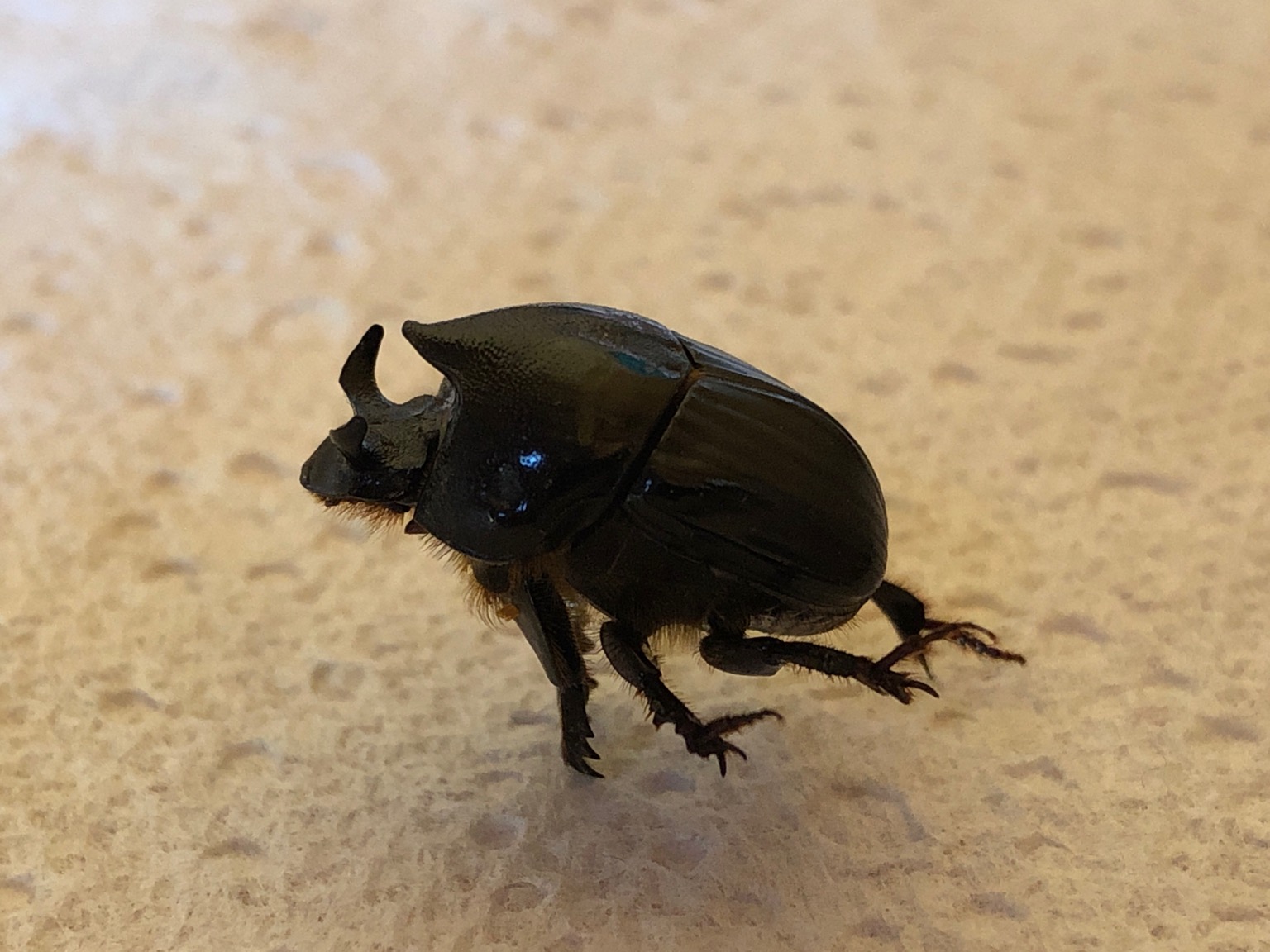
Lastly, my beloved dung beetles. The pic below is of a big healthy B. Bison boy that we captured in a trap at the beginning of winter. I was ecstatic to find him (and a few of his friends and family!) as this is a great sign that our dung beetle-friendly horse management program is working. B. Bison is a wintering beetle that will remain active all winter, during manure up to 40cm below the surface and effectively conditioning our soil. Go little guy!


Unfortunately, as the fox scat on the left shows, our resident fox/es eat dung beetles. You can see in the bottom third of the picture the black body parts of the beetles in the grey remains of the scat. This is something to watch out for if you have an abundance of foxes. Just one more reason to work on controlling and eliminating feral animals.


And lastly, more evidence our management approach is really paying off. This picture is one I took when I moved a horse tyre feeder last week. See all those worms? They just weren't there two years ago. I recall planting trees and never seeing a worm in any of the holes I dug. Worms really do tell you how your soil is going and this seems to be a pretty big tick!

11 April 2020

Dung Beetles and Horse Wormers

Well, it's been a while, but considering we have lived through catastrophic bushfires and now a global pandemic, I think I have a good excuse not to have written a post in a few months! I hope all who read this stay well and sane and that we all come out the other side of this incredible upheaval soon enough.

Here at Pine Hill, though, the work hasn't stopped. And I wanted to collate my last few months of research and reading on the effect chemical wormers have been found to have on dung beetle populations. I started this little side project when I realised I would absolutely need to worm my horses this autumn for bots, given the number of eggs I was seeing and trying to remove (and with over a dozen horses on the property, spending hours a day removing bot eggs just wasn't feasible!). The list of 'safe' wormers I had been given by the Landcare dung beetle group only mentioned cattle and sheep worming products so that was no help whatsoever.

I had wanted to undertake worming as needed using Fecal Egg Counting, however I realised there are significant problems with this approach. The first is that not all invasive worm species leave eggs in dung - bots are a good case in point. Second was that I would have to either send specimens off fairly regularly for examination, or drop a cool $500 or so on my own microscope (which I DO plan on doing when I can!). Lastly, it was a very troublesome and time-consuming task to identify manure from individual horses, grab it before the beetles did, wrap it in damp newspaper and a plastic bag, label it and stick it in the freezer. I wanted to have tests connected to individual horses rather than just herd samples so I could really target my worming program. Given that I work full-time and have two kids, this just wasn't working.

So, I began to research horse wormers. Here's what I found (all sources listed at the end):

The active ingredients in wormers used to be fairly simple and basic: ivermectin was by far the most common, and still forms the active ingredient in most wormers on the market - in one form or another. Ivermectin has since been formulated into more potent (and therefore lower doses can be used) compounds such as avermectin and abamectin, as well as eprinomectin (safe for dairy cows) and doramectin (produced less discomfort to the animal on administration). Ivermectin and related drugs are very toxic to dung beetles in Australia. From here on in, when I refer to 'ivermectin' I'm including all the variations listed above.

I focused on research conducted in Australia and other like countries with dry summers and cooler wetter winters (ie South Africa, parts of America, Spain etc) rather than UK studies or studies in tropical countries. It appears rain and humidity have a significant impact on the mortality/adverse effects of ivermectin etc on beetles. Studies showed that:
  • As horses aren't ruminants (ie they don't digest their food to the same stage cows do, for example), they excrete their food much faster and don't breakdown/metabolise the wormer in their gut at the same rate. This means that horse dung contains much higher concentrations of toxins than cow manure and is therefore more toxic to dung beetles.
  • Ivermectin significantly reduces dung beetle brood emergence and brood take roughly 2.5 times longer to emerge than normal. So, this slows the beetle breeding rate significantly.
  • Ivermectin kills all the dung beetles ingesting treated dung for at least the first 24 hours post-worming and this mortality rate gradually reduces to no apparent effect on the beetles by day 6. 
  • Ivermectin-treated manure is actually really attractive to dung beetles for up to 30 days! So, if you treat one horse with ivermectin but the others in the paddock aren't treated, the dung beetles will prefer the treated dung and this obviously results in higher mortality. 
  • Specific species of dung beetle are more susceptible to ivermectin than others. For example,   O. Binodis is highly sensitive - ivermectin is 100% lethal to Binodis for the first week and it takes over eight weeks for ivermectin to have no measurable effect on this beetle. 
  • The ecotoxilogical effects of ivermectin are much more severe in drought conditions.
  • Abamectin/ivermectin remain in dung samples for up to 180 days. Abamectin is particularly nasty for dung beetles in any concentration at all. Similarly, eprinomectin is highly toxic to dung beetles, reducing the next generation by 25%-30%.
From this research I could ascertain that, if you must use ivermectin-based wormers:
  1. Keep your horse away from your pastures and pick up and bag all manure from that horse as quickly as you can, for at least the first couple of days and this will drastically reduce the effect on your dung beetle population. 
  2. High rainfall appears to mitigate the detrimental effects on dung beetles - so if you are considering using an ivermectin-based wormer, wait til it's about to rain and this will help alleviate some of the toxicity to dung beetles.
However, there really isn't a safe way to use ivermectin and its variants in relation to dung beetles. Ivermectin stays around for over four months, though only abamectin, the most toxic variant to dung beetles, is still harmful by this time.

Why don't we just use wormers that don't contain ivermectin, I hear you ask? Well, there really aren't many that don't, and those that don't generally don't treat horses for all known worms, including bots. I have an annual worming program - ie I only worm all the horses once per year - in Autumn. There is really no way to get rid of bloody bots, so I must use a boticide. The usual 'dung-beetle safe' or 'rotational' wormers don't do bots too.

The main wormer I had used before was 'Strategy T', manufactured by Virbac, and containing oxfendazole and pyrantel as dual active ingredients. Oxfendazole appears to have no observable effect on dung beetles (yey!) and pyrantel is similarly benign for invertebrates but the thesis is that it may adversely effect your soil microbiome and potentially earthworms. Either way, it doesn't do bots, and this made it a bit useless for me.

With regard to boticides, there is one active compound mentioned in the research that seems to be less toxic to dung beetles. Moxidectin, at recommended dosage levels, appears to have little effect on dung beetles, particularly after 2 days. However, at higher levels this compound is problematic and it seems to be somewhat toxic to dung beetles for the first two days at least. This is one of the active ingredients in Equest Plus Tape, made by Zoetis.

The other active ingredient is praziquantel. This is non-lethal and appears non-toxic for dung beetles. I could only find one study that tested praziquantel but it showed a definite lack of lethality until extremely high doses. 

I receive absolutely no sponsorship from Zoetis (or, for that matter Virbac) and have no relationship with either company. I found the array of wormers on the market completely baffling and decided to sit down and do my own research to make sure any chemical wormer I'm giving my horses is as safe for my beloved beetles as possible. So, I'm giving Equest Plus Tape a go for this round and will closely monitor my beetle populations.

I have just discovered our very first B. bison, a wintering beetle. This means we finally have dung beetles working on our property all year round! The bison is a great beetle, burying its brood in balls of manure 20-40cm below the dung. This is some deep soil conditioning going on all winter long. Love it. However, this is also worrying if I'm using a chemical wormer that may have an adverse impact on those beetles. I think at this point it's a matter of weighing up your options and just doing the best we can!

Please leave comments or questions and I'll do my best to answer them. Or just email me at pinehillpastoral@gmail.com.

References:

Jacobs, C.T. & Scholtz, C.H., 2015, ‘A review on the effect of macrocyclic lactones on dung-dwelling insects: Toxicity of macrocyclic lactones to dung beetles’, Onderstepoort Journal of Veterinary Research 82(1), Art. #858, 8 pages. http://dx.doi.org/10.4102/ojvr.v82i1.858

Alexander, M. & Wardaugh, K., 2001, 'The Bardon Report' (Workshop on the Effects of Paraciticides on Dung Beetles', CSIRO Entomology Technical Report No. 89

Hempel, H. et al, 2006, 'Toxicity of four veterinary parasiticides on larvae of the dung beetle Aphodius Constans  in the laboratory' Environmental Toxicology and Chemistry, Vol. 25, No. 12 pp 3155-3163

28 January 2020

Summer Pastures

Wow. What a summer it has been so far here in country Victoria. Between the heat and the fires and now the beautiful temperate weather with a decent bit of rain, it has been a really weird summer full of stress and uncertainty. We have been very lucky here at Pine Hill to escape direct fire threat, though it looked bad for a few days there, and we are very mindful of our friends and communities around us that are doing it tough right now. Summer is not over, though, so we are not relaxing just yet! To be honest, it feels like we'll never be relaxed again.

But on to more blog-relevant things! I thought I would do a post about managing pastures in the hot dry of summer. When I say 'pasture' I mean the grass that is growing in your paddocks, I don't mean the 'improved' green stuff that farmers/croppers grow for hay or cattle. I specifically want to talk about the mix of mainly native with some introduced species of grasses we have actively encouraged on our property. This mix of grasses seems optimal for horses and we have never had a case of laminitis, obesity or colic in our horses while grazing on this kind of pasture.

The following two pics are from late spring. We obviously had OK rain (still below average but far better than our friends in NSW and QLD) and we made a really concerted effort to rest paddocks for a number of weeks to give spring grass the opportunity to grow. We have found the number one thing we do that makes a big difference to grass coverage and quality is spelling. When grasses have a decent opportunity to recover, they do it with a vengeance. All the fertiliser, foliant and soil conditioner in the world won't do squat if the stocking rate is static and your grass never gets a chance to grow.


This paddock had a good 10 weeks' rest. You can see the green shorter grass and longer yellow grasses in there. Both are natives - I think the yellow is 'hairy panic' (I shit you not, that's its name!) and the green is either kangaroo or wallaby grass. I talk more about this paddock further down as its taken a lot of work to get it to this point!


The paddock on the right (featuring the gorgeous Irish girls Annie and Rose), had a big spell of about 4 or 5 months over winter. This paddock is a bit of challenge because of the stand of radiata pines that grows on the top of the hill off to the left of this photo. This species of pine, commonly used in plantations for decking and playgrounds, really acidifies the soil. Nothing but weeds grow beneath these trees, unlike the native pines that grow around our place. So, I sprayed this paddock for flatweed in the autumn and left it. It's already quite improved. That black rock is granite and there is a lot of sub-surface water in this area. Don't be fooled by the green strip - that's flatweed I missed! The whole paddock looked like that.

The second big thing that affects our pasture is when the dung beetles really kick off. The manure on the left has been 'dung beetled' and you can see the flattened, chewed up appearance of the dung. The beetles have essentially processed the manure, sucking the water out of it and burying it in the soil underneath in a series of holes, some up to 10cm deep. This obviously conditions the soil over time and provides much-needed organic matter. We LOVE our dung beetles.

A by-product of dung beetles is the protection it gives the soil and grasses underneath the dung from the drying heat of sun and wind. You can see the green grass shoots pushing up through the manure and around the dung pile itself. Yes, some of this is nutrient-driven, but the manure acts as a mulch, too, and I think this has quite a positive effect over summer.
Good for our native birds, but not so good for the dung beetles, but the beetles are a great source of protein! The magpies, along with the water birds that flocked to our place this summer because of the drought to the north, liked picking through manure for the beetles. Bummer, but hey, I can't speak ill of the maggies. They are wonderful birds and they didn't do much damage to the beetles population!

The dung beetles were really late and a bit patchy this summer. I heard from other dung beetle monitors that the beetles were not at usual levels by December, and it was interesting that we had a really high number of E. fulvus but very few of our other, more common species, like O. aygulus, O. binodis and O. taurus. However, by mid-January, O. fulvus was on the definite decline (or at least back to more usual levels) and the other three species were in much more abundant numbers. Not sure what to make of that. We had a couple of very cold nights quite late in the year (November) and some very hot days very early in the summer (40 degrees plus), so that may have affected the breeding and emergence of some of the beetles.

 These next two photos show the grass cover we've managed to maintain this summer. You can see the smoke haze in the distance - this was before the big fires really took off to our south and we couldn't even see those hills in the distance! This paddock had been spelled for about two months and had received about 10mm of rain in that time.


The diversity of grasses is pretty clear in this lower photo. This is a different paddock, one that has been pretty difficult to get to this point (this is the paddock I mentioned at the start of the photos). Situated on a big open slope, with no mature trees to date, this paddock was just choking with flat weed. I have sprayed it at least four times over two years with MCPA, mainly to knock out the flatweed, but also twice in spring as stork's bill really took off.

There is a big soak running through this paddock and I planted five trees when we first arrived, all of which are now established and three feet tall now. The big black lump is a granite rock and you can see the gully we are now fencing off and rehabilitating off in the distance at the top of the photo. Because of the water within the soil, I have had to be very careful about timing of the herbicide application. Too wet and it will contaminate the water course, too dry and the dying weeds will just leave big bare patches of dirt that will either blow away or be colonised by other weeds.

The take home message here is that, once summer hits its really too late to do much to improve the grasses you have. Summer is not the time to be putting down fertiliser or trying to grow grasses. Unless it rains a lot! But putting the work in during the Autumn to Spring seasons planting trees, spelling paddocks, applying soil conditioner or foliant, moving away from chemical wormers to encourage dung beetles, all of this will vastly improve your likelihood of maintaining grass cover over summer. Drought is a whole other thing, but there is now an expanding area of research into approaches like natural sequence farming that essentially drought-proof your property. That's our next holy grail!

26 October 2019

Pasture Diversity

Happy Spring! It's really kicking off now at Pine Hill with lots of lovely grass and flowers all over the place. We have been blessed with some fantastic rain over the past three or four months and this has really kicked off our growing season well.

We have some pretty gnarly weather this time of year with some amazing storms (like today with 80km/hr winds and hail and thunder!) that bring down trees and have Charles out with the SES all over Beechworth clearing fallen trees from roads. But this year we have already had two very hot days (over 35 degrees Celsius) which makes us very nervous for the summer ahead.

This post is going to cover pasture diversity, specifically looking at the benefits diverse grasses, herbs and plants bring to your pastures. As we grow pasture for horses, we have tried a few different things to date when it comes to the best pastures for horses, and there are some interesting things we have learned along the way! I will do my best to share our knowledge so far, but am also really keen to hear from anyone else out there with experience and knowledge to share.

There are a few basic pieces of information that ground our approach to 'grass farming' for horses. The first is that most grasses traditionally grown for horses are in fact far too sugar-rich and will make horses sick. Laminitis, basically the inflammation of the soft tissue under the hoof that can be fatal if chronic and severe enough, is linked to a high-sugar diet in horses. Grasses commonly grown in temperate Australia for cattle, such as rye, clover, paspalum and fescue are not great for horses and cause all sorts of issues. Other grasses like kikuyu can cause major issues like 'big head' which is literally overlarge heads in growing horses.
This paddock was just flat weed when we moved in. The pines at the top of the hill really acidify the soil so we're pretty happy the grasses have started to take off here.
The grass with the bulb on the end is actually a wildflower rather than a grass. But it is the only thing that grows in winter and the cockatoos love digging them up and eating them (clearly what happened here!)
A clear mix of a hardy buffalo type grass with several native grasses growing in the background. The bare patches are probably from weed spraying in the months prior.

 Most pony owners know not to buy clover and rye hay, for example, as the sugar content is just too high for it to be safe. But there is more to pasture management than just making sure you aren't sowing rye and fescue. There are a number of issues to consider when looking to develop a good horse pasture:

  • Variety is incredibly important to soil health, horse health, sub-surface water and the soil microbiome. Monoculture is not the way to go. Some regrarians recommend about 50 varieties of grass, herb and plant in your pasture at any one time. We certainly work to this rule, as you can see from the photos above, where it is possible to see a number of grasses and plants growing in our paddocks.
  • Get your soil tested so you know what to encourage or sew to help your soil out. For example, clover and lucerne will fix nitrogen in your soil. Most temperate native grasses will grow when the soil is acidic and will help take up nutrients into your soil, providing food for microbes and worms to establish.
  • We initially wanted to focus on native grasses only but found they just recover too slowly to allow 'commercial' stocking rates on the land. Basically, on a wholly native pasture, we could only really have 5 or 6 horses on 90 acres without hard feeding the whole time. We adopted the mixed pasture approach we have now and it seems to be working much better.
  • Your rainfall will greatly affect your biodiversity. Some grasses just don't cope without consistency rainfall while some go gangbusters.
  • Trees encourage grass. This is perhaps counter-intuitive, but the more trees you plant, the more and lusher grass you will grow. This is for a couple of reasons, including the 'second' watering the grass gets from leaves showering rain down after the rain has stopped, shade given by trees from the hot Australian sun and the frost, but mostly from the change in soil and water that occurs under and around trees. We are aiming for a park-like environment with a lot of trees throughout the paddocks and a lot of grass underneath.
We've taken a bit more of a relaxed attitude to weeds, too. The consensus among regrarians now is that weeds can be as much of a good thing as a bad thing. We are still in a spraying cycle (we use MCPA - a broad-leaf selective herbicide) but we are in a much better position than we were last spring, for example, as the soil pH has greatly improved, our soil health is far better, and we are really growing a lot of good plants in comparison to not so good.

We used a combination of NPK (nitrogen, phosphorous and potassium) - and now we're getting into hotter months we use a 'Sticker' additive that is an organic oil compound that melts the shells of little bugs like red legged earth mite and reduces grasshopper infestations) - provided by Goode's Organics in combination with the MCPA. This provides the growing grasses with a boost while killing off the undesirable plants like stork's bill (also called false radish), flat weed and cape weed. Once we aren't spraying for weeds we will add 'CalMag', Goode's calcium and magnesium liquid soil conditioner and spray that on every 6-8 weeks as we go through the summer. We can't spray the CalMag with the MCPA as the particles get too thick and they'll clog up the sprayer.

When we first decided to use a liquid fertiliser/foliant, we were a little concerned about the effect of fertiliser on the native grasses we were trying to encourage. We had read some material that cautioned not to fertilise native grasses as it would basically kill them off. These are, after all, plants that had evolved in pretty hot, dry and nutrient-light environments, so fertilising them or moving the pH too much into the alkaline was thought to be detrimental.

What we found, though, was that native grasses seem to do quite well using this level of soil and foliant conditioning. We have seen our Wallaby, Weeping and Kangaroo grass really take off, not to mention the Hairy Panic (yes that's actually a grass!), Native Millet and a range of others. The photos all show a strong mix of native with introduced grasses and plants, and this has occurred over just three years. We've only been spraying with Goode's products for less than a year.
A very healthy paddock after a couple of sprays with the NPK/MCPA mix and some good rain.

Some lessons we have learned are that the best results come when the pasture is given lots of time to recover from grazing, and that weed control is a real kickstart for a bunch of grasses and herbs to establish. Not weed eradication, mind you, but weed control. Most weeds can be out-competed by a range of healthy grasses and it's important not to allow bare earth to sit bare without grass seeds on it for long. Where there is bare earth, a plant will grow, and it's usually not the one you want! We've tried mulching with old hay (not rye/clover!) and a manure/hay/ashes mix that I spread twice a year made of horse and chook manure from our chook shed, lucerne hay I sweep out of the float, ashes from the fire over winter and anything else I think will go ok. I put a bunch of used recycled paper cat litter in there over winter and it seems very popular with the worms! These things that cover the bare earth create a really great environment for grass/plant seeds to establish.

Creating more paddocks has also been a big help as it gives whole sections the rest when before the most tasty grasses and plants would have been over-eaten while other grasses were ignored. This effectively gives you an abundance of all the plants you don't want! By locking up and resting paddocks, you give all the plants the time to grow well.

There will be more on this topic over the years as we go forward. We are learning so much about how to manage pasture for horses in the temperate Australian climate. We have stopped harrowing a lot, for example, despite the Equicentral approach advocating for a constant cycle of harrowing and slashing. The dung beetles do a good job, but we also try to move horses off paddocks before there's too much manure to worry about. It's maybe not ideal, but it saves us the petrol and time of harrowing, plus we leave the top-most layer of grass and soil alone. We found harrowing was pretty damaging to that level of the pasture.

As I said at the start, comments, questions and suggestions are very welcome!
Native grasses starting to compete with a herb.

Sun Dew - a carnivorous native plant that has sprung up in all the damp places.

Another mix of plants, some weeds (flat weed in the foreground) and some bare patches. This paddock is close to the house and has been used over winter so is showing signs of stress.

09 September 2019

Dung Beetles - a beginner's guide

Happy Spring Time! I can't believe how long it's been since I wrote another instalment. Apologies - spring is a busy time as I get the veggie garden sorted and ready for all the planting and try to get on top of weed spraying and seeding bare paddocks. Let alone the handling of the lone weanling ready for his first trip in the float to the vet for the snip. Poor little guy handled it like a trooper!

So, dung beetles. If those two words don't fill you with excitement and joy now, I hope by the end of this post they will! I absolutely love these little (and not so little!) beetles and I can see the change to the paddocks even in the two years we've been actively managing for them.

Dung beetles are a broad classification of a family of beetle introduced to Australia, mainly from Africa. They only eat the dung of ungulates (mammals with hooves), though one or two species have been shown to get involved in native animal dung. Most adult dung beetle species feed on the liquid in manure (poo juice!) and use the fibrous material in the manure to make 'brood balls' which they bury in the soil, some as deep as 30cm.

One of the most common beetles at Pine Hill, O. Binodis
The dung beetles in the north, hotter and more tropical regions differ markedly from the dung beetles I'll be discussing here. The tropical beetles have long front legs that they use to make dung balls ('ball rollers') while the beetles we see down here at Pine Hill are 'tunnellers' and don't have the long appendages.

We are just about to get into dung beetle season, and it can't come quick enough! Currently, we have about 5 species on our farm, with the odd blow in of 2 other species trapped on occasion. They are all spring to autumn beetles, meaning they are only active in the warmer months, though we hope a winter beetle will be released and available for us soon so we have all year round activity.

Dung Beetles On the Farm
Here's how the beetles work on our farm (and yours too, if you make the effort to manage for them):

  1. The beetles are immediately attracted to fresh manure and fly from everywhere to land on it and start processing the pile. 
  2. They will start drinking the poo juice (yum yum!) and digging the fibrous material down into the earth, usually between 10cm and 30cm deep depending on the species.
  3. The average horse poo pile is reduced to a flat, completely processed dry pancake in under an hour. No need to harrow.
  4. Without the liquid in the manure, flies do not lay maggots in the poo and even if they do the maggots don't survive. We have NO flies in summer - no need for fly masks for horses or hoomans alike. I shit you not. 😂
  5. As the manure is completely processed in super-quick time, any parasites or internal eggs shed in the manure die. 
  6. The beetles essentially condition the soil for months, digging manure in to the soil, adding organic matter to the earth and helping the earth worms and soil microbiome. 
  7. Did I mention no harrowing?
How To Manage Horses For Dung Beetles
There is one golden rule: do not use chemical wormers except the one horse wormer that appears to have no effect on the beetles and that's Strategy T. This is the wormer we use in spring, if needed, but it is preferable to use Fecal Egg Counting to get an accurate picture of your horses' worm burden.

Other management techniques that will help reduce the likelihood your horses will even have a parasite burden include:
  1. Frequent paddock rotation. Always have a paddock or area of land resting that you can move your horses onto. 'Set stocking', or keeping your animals on the same land with no rest, is a risk factor.
  2. New horses must be wormed prior to joining the herd, or better yet coming onto the property. Even better, get the new horse's FEC done so you can avoid worming if it's not needed.
  3. If your horse is in a little paddock and you have no choice but set stocking, pick up the manure and compost it once a week. To be honest, this kind of management is far from ideal but resting the paddock as often as possible is really important. Removing the manure from the paddock also removes all the beneficial soil conditioning it offers. If you can remove the horse for a month and harrow in all the poo every few months, that is far better.
So, hopefully I've convinced you to give dung beetles a go. They are just the most amazing little critters and I can't WAIT for them to arrive this year! It's pretty easy to encourage them onto your property by just not killing them off with wormers. We did nothing at all to get them back onto our
A big beetle and very welcome here at Pine Hill, G. Spiniger

place, they just started arriving two summers ago and we've never looked back! Now we're part of the Dung Beetle Monitoring program run by Landcare and will hopefully play a small role in the big research program being run by Charles Sturt University. We're true Dung Beetle Fans!

If you're keen, please check out this website: http://www.dungbeetle.com.au 

25 July 2019

Rehabilitating paddocks Part 1

Welcome to the first post looking at how we are going about regenerating our paddocks. This is a long-running project that will likely take several years more to achieve our desired outcome, so this will be the first post of several over time.

When we bought Pine Hill in 2016, the property had been largely neglected. There were few fences and the entire property was infested with flatweed (also known as false dandelion or cat's ear). This weed is a neurotoxin for horses and is a major cause of 'stringhalt', a sometimes irreversible neurological disorder characterised by exaggerated raising of the hindlegs. Obviously, not ideal for a horse property!

Other than the flatweed, the major issue was the lack of appropriate pasture. Either the grasses growing were unpalatable for horses, too high in sugar (think rye and clover) or just missing in action. As can be seen from the photos below, there were large patches of bare earth, a heavy infestation of flatweed (and later, capeweed and false radish), tufts of native grass and few trees.
Add caption
About 50cm x 50cm patch showing good grass but a flatweed plant with dried stalks in the bottom centre. This is typical of late winter/early spring time.
This is of the highest part of the property, looking across the fence into what is about to become a completely fenced off area subject to a grant to rehabilitate the creek.
Day-old 'Chopper' the young stallion but you can see the difference between the overgrazed paddock where the horses are and the entirely native/unimproved pasture in the foreground.
 The photos shown were largely taken in late winter/early spring and show a lot of greenness and saturated ground. The winter we moved in was one of the wettest on record (it rained every single day for three solid months!) but even so, the grass growth was minimal and not nutritionally significant.
The best paddock 'Kelly' supporting the majority of the horses at this time

 We made the decision to get the soil tested to give us a baseline and decide what to do and what needed to be put down on the property. The soil test was informative - the pH was not as low as we were warned it would be - at 5.1 it was certainly acidic but, considering the amount of pine trees and the degraded paddocks, we thought it would be in the 4s! On the back of that test, we decided to put down lime and dolomite in the amounts suggested by the soil testing company (SWEP, for Australian property owners who are interested). Lime takes about 6-12 months to really start making a difference, though, so it would be a long wait before we saw any improvement!
A typical 50cm x 50cm patch showing flatweed 
Coming into spring, we made the decision to start spraying for flatweed. While soil pH is a huge factor in what plants grow well where, we decided that flatweed, being toxic to horses, needed to be eradicated as quickly as possible. One horse had already shown signs of stringhalt so the situation had become more urgent.


This was a fraught decision as we were becoming very aware of how much water runs through, under and over this property. We live on a big hill and all the water passing through our place ends up in beautiful creeks. We wanted to use as few chemicals as possible. The property has a number of soaks (areas where sub-surface water is very close to the surface) and two watercourses that ran when there was significant rain, as well as three dams and an abundance of waterbirds.

Because of this, we decided to use the lease toxic herbicide we could and settle on MCPA. This is a broad-leaf selective herbicide that (currently!) is considered relatively safe. Even so, we have applied it only once on any area at this stage and have sprayed in sections, rather than doing the whole property at once to minimise saturation with the chemical.

The spraying program has been remarkably effective and there is a significant reduction in flatweed in sprayed areas. We will need to re-spray this spring to really get on top of the flatweed, but it's been a successful approach on the whole, and the spray does not seem to have affected frog and dung beetle populations (more on those later!).

In addition to the spraying, we set about planting trees. You can see from the photos that there were very few large trees (about five!) on the entire property and most paddocks had zero large trees in them. We sourced 50 trees, as well as trees from Landcare (about a dozen per year) and we planted them in various areas with limited success.

The trees planted in the higher sections of the property all died during the summer (even when watered in some cases). Very few trees have survived a full year, though interestingly one paddock has five growing young trees while another has none. However, a change in planting technique is hopefully changing the game and there may be a better rate of survival from now on! We now use the 'deep planting' technique where tubestock are essentially buried as deep as possible with only the tip of the plant emerging from the ground. It goes against all reason but it seems to be working!

On to dung beetles. There will be a whole post on dung beetles next week, so I will keep discussion of dung beetles here very brief. We were introduced to dung beetles as a seriously important tool in our property management last year and Nadia did a short information session in the height of summer at the end of 2018. She came back completely sold on the importance of dung beetles and Pine Hill is now a 'Dung Beetle Monitoring Site' for the Landcare project, conducting fortnightly counts of dung beetles on the property.

We realised early on that the soil lacked organic matter and there were no earth worms in the soil that we disturbed while planting trees. Once again, composting manure and other organic matter such as grass clippings and ash from the fire will be covered in depth in another future post, but we decided to look for a soil conditioner/fertiliser we could spread ourselves that was organic/biodynamic. The manure mixture we made was very small scale and simply inadequate for the size of our property.

We settled on Goode's Organics and started spraying the 'NPK' (ie nitrogen, phosphorus and potassium) and 'CalMag' (ie calcium and magnesium) onto paddocks every 8 weeks or so. We are able to use NPK with MCPA, which is very useful in providing a boost to 'good' plants while killing off weeds. We also wanted to try Goode's' 'sticker', an additive that targets insects by melting exoskeletons, particularly in red mite which attack grass roots and are incredibly difficult to get rid of. We think there's been a clear result using these kinds of products and will be keeping tabs on those results into the future.

Our last approach to paddock improvement was with regard to livestock management. We implemented a rotational grazing schedule that used the Myers' method of 'loafing areas'. In this model, a single, central large area is created with a water source and paddocks are fenced around this area. There is a single herd of horses that moves from a paddock to the loafing area to drink and stand around, and they are easily moved from one paddock to another simply by opening gates. More on this in another post!

We use the 'sacrifice' approach in winter and summer at the moment, meaning one paddock is essentially trashed over winter while we rest the others. We began this winter with three sacrifice paddocks, one for each herd, but as we started to run short of round bales of hay, and with hay prices climbing and climbing due to the drought in NSW, we abandoned this approach in two of the three herd areas. The photos below show the remaining sacrifice paddock and the three horses in it with their precious bale! You can see how trashed it is, but it is the worst one anyway in terms of weed and  lack of trees, so this will be intensively rehabilitated come spring time.

The photos below are of the paddocks this winter.

A clod of earth dug to plant this winter's trees. You can see the colour and organic matter.

The hole with a big fat earth worm just visible on the left of the hole.

The sacrifice paddock. Lucerne hay in the mornings, hard feed in the evenings and a round bale 24/7. And mud

About 1m x 1m patch


The approaches we are using are largely trial and error. We are not sure what the best pH is for the soil when we are aiming to grow a mix of native and introduced grasses. The soil test we did in autumn showed a pH of 5.8-6.1 so that's a big improvement. We have decided to just proceed with organic matter for a while and see how that goes - we are very keen to encourage native grasses (yes, that's another post for another time!) and there are no guides out there for how to grow a native/low sugar grass mix for horses.

Stay tuned for another post next week looking at dung beetles. Thanks for reading!

Same paddock - sacrifice seen over the fence on the right. 
The rested paddock next to the sacrificed one.

16 July 2019

Welcome to the show!

Greetings!

Welcome to the blog by an Australian couple who want to breed, keep, train and grow horses in harmony with the Australian environment - and who want to share our successes and failures with anyone who is interested! We are Charles and Nadia, residents and owners of Pine Hill, a 93 acre property in beautiful north east Victoria, where we have a little Australian Stock Horse Stud of the same name, and live with our two kids.

This is pretty much what our place looked like when we moved in nearly three years ago. It is located entirely on a big hill with plenty of granite rock and two little watercourses, both of which only flow when it rains fairly heavily.

It looks nice and green but most of that green is flatweed (also known as false dandelion or cat's ear), which is a weed toxic to horses and causes neurological problems and liver damage. Not good for a horse stud!

There were only a couple of fences on the property, some in excellent condition, some not so much. There are three dams - we call them 'Top', 'Middle' and 'Bottom', somewhat unimaginatively, and of the three, Middle dam is the best for water quality and storage capacity, followed by Top dam and Bottom dam. We will come to Bottom dam later!

The previous owners had not done much to the property in the thiry-odd years they lived here, other than build the house. Even the shed and shearing shed pre-dated the house! The land was overgrazed by goats and cattle, and there was barely a tree on the place. There were two paddocks that looked pretty good and had been 'improved' at some stage (meaning some kind of fertiliser had been applied) and the neighbour had grazed his cattle on those paddocks at various times to help keep the grass down.

We came to this property from one about a quarter of the size on the outskirts of Canberra where we had tried a couple of the techniques and property planning approaches we will discuss in this blog, but the land is much drier in Canberra and far more unforgiving! The rainfall in this part of the world is almost a third more per annum (climate change notwithstanding) and the winters are far less harsh than the Canberra region. Summer here is hot - last summer we had nearly 4 weeks straight of 35+ Celcius without a break which was record-breaking, but that is to be the new normal, and this region is the last to be really negatively affected by climate change; one of the reasons we moved here.

We decided to breed Australian Stock Horses a few months after moving here, mainly because of the versatility of the breed, and the general athleticism and temperament of the horse. We acquired a two-year-old colt from Pipersrun Stock Horses up near Dubbo in 2017, and decided to keep our first born colt (2016 drop) entire after seeing how stunning and quiet he was an a yearling. These two, Pipersrun Captain Thunderbolt (Jack) and Pinehill Cool Constable (Chopper), became our foundations sires.

Jack as a 3 year-old

We also decided to keep our band of mares very small as we want to limit the number of horses the property supports and this gives us a buffer if we don't sell youngstock every year. We now have four mares - two thoroughbred and two Heritage ASH mares - and plan to have two in foal per year. This cycle of breeding every second year seems optimal, as it gives the mares time to replenish their body weight and calcium and other minerals before the next foal.

This blog is also a place where Nadia in particular (the horse person of the couple!) will talk about ethical horse management and training. Nadia has trained with the Australian Equine Behaviour Centre founders Dr Andrew and Mrs Manuela Mclean for her entire riding life (since the age of 8, we believe!) and has benefited enormously from their relentless pursuit of better and more ethical training approaches to horses. There is also a growing body of research looking at the best ways to house, manage, feed, train, breed and grow horses, and this will form part of this blog too. You'll be getting a warts and all blog as we talk about what has and hasn't worked, and all the lessons we've learned along the way!

Our overarching mission has been to rehabilitate our property, but also to find the best and most effective methods to farm our horses in harmony with the Australian environment. We have found a real lack of material out there talking about regrarian/sustainable/environmentally friendly farming for horse people. There's a lot about cows and sheep but nothing much about horses - who we all know are completely different in many ways. Behaviourally, nutritionally and emotionally, horses are just not like other livestock. We also use them and interact with them on a daily basis so just sticking them out in a paddock isn't going to work.

So, come along for the ride and join in on the comments below. Ask questions, share wisdom and give feedback as we go. We aim to post every week on a different topic, project or problem we're having. Stay tuned!